Battlelines by Tony Abbott
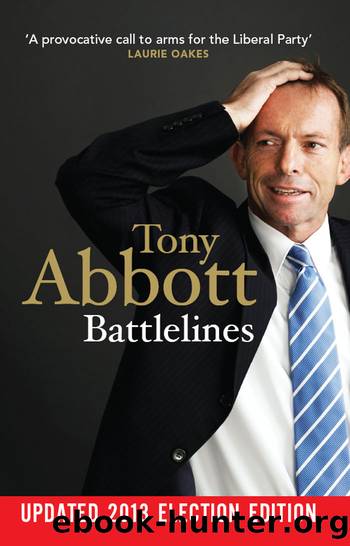
Author:Tony Abbott
Language: eng
Format: epub
Publisher: Melbourne University Press
Published: 2022-09-10T00:00:00+00:00
A Fair Go for Working Mothers
As Turnbull recognised in this speech, itâs not enough to give more support to families once they have children. Women also need support in their initial choice to become mothers. Because women are normally in the workforce before they have children, this means the provision of effective maternity leave. People in the workforce canât normally forgo their income, even temporarily, without careful planning and a great deal of preparation. For mothers-to-be, thereâs not only the need to maintain income but also the natural instinct to be with their babies at least for the first few months of their lives.
The Howard Government did much to support womenâs choice. It tripled spending on child care and doubled the number of childcare places available. More flexible workplace arrangements made it easier for mothers to choose to work part-time or to have family-friendly hours. Under the Howard Government, the participation rate for women aged twenty to forty-nine rose from 66 per cent to 71 per cent, and for lone-parent women with dependent children from 40 per cent to 52 per cent.21 One challenge that the former government inadequately met, though, was the establishment of a national maternity-leave scheme.
This was a difficult nettle for the former government to grasp. It encouraged businesses to provide some form of paid maternity leave (the Productivity Commission says that 53 per cent of women in the workforce have access to it) but was consistently reluctant to go further. Requiring individual businesses to offer paid maternity leave would have made younger women less employable. On the other hand, a taxpayer-funded paid-maternity-leave scheme (including the one that the Productivity Commission recommended) would have discriminated against mothers who werenât in the paid workforce. In part, the Baby Bonus was conceived as a way to resolve this dilemma.
Cabinet saw the Baby Bonus as a form of maternity leave for women in the paid workforce and also as recognition for all mothers of the cost of having children. It was set at $5000 because that was more or less the value of twelve weeksâ pay at the then minimum award rate. To womenâs groups, however, it could not be considered maternity leave, precisely because it was a universal payment. To count as maternity leave, it had to be a benefit provided only to women in the paid workforce. The right to time off to have children, they said, should be as much a normal condition of employment as time off to recover from illness or for holidays.
The Rudd Governmentâs proposed parental leave scheme is only for women in the paid workforce, but itâs not funded by business as, by rights, it should be. At eighteen weeks, itâs not long enough to allow women fully to breast-feed their babies and, at the level of the minimum award wage, itâs inadequate for most families that depend on a motherâs income. In some cases, accessing the $9700 taxed maternity leave payment will leave women worse off than they would be with their existing untaxed baby bonus and family tax benefits.
Download
This site does not store any files on its server. We only index and link to content provided by other sites. Please contact the content providers to delete copyright contents if any and email us, we'll remove relevant links or contents immediately.
| Anthropology | Archaeology |
| Philosophy | Politics & Government |
| Social Sciences | Sociology |
| Women's Studies |
The Secret History by Donna Tartt(19096)
The Social Justice Warrior Handbook by Lisa De Pasquale(12191)
Thirteen Reasons Why by Jay Asher(8914)
This Is How You Lose Her by Junot Diaz(6890)
Weapons of Math Destruction by Cathy O'Neil(6282)
Zero to One by Peter Thiel(5804)
Beartown by Fredrik Backman(5759)
The Myth of the Strong Leader by Archie Brown(5510)
The Fire Next Time by James Baldwin(5450)
How Democracies Die by Steven Levitsky & Daniel Ziblatt(5219)
Promise Me, Dad by Joe Biden(5154)
Stone's Rules by Roger Stone(5088)
A Higher Loyalty: Truth, Lies, and Leadership by James Comey(4965)
100 Deadly Skills by Clint Emerson(4927)
Rise and Kill First by Ronen Bergman(4790)
Secrecy World by Jake Bernstein(4754)
The David Icke Guide to the Global Conspiracy (and how to end it) by David Icke(4720)
The Farm by Tom Rob Smith(4514)
The Doomsday Machine by Daniel Ellsberg(4491)
